
Irrigation Principles | Evapotranspiration
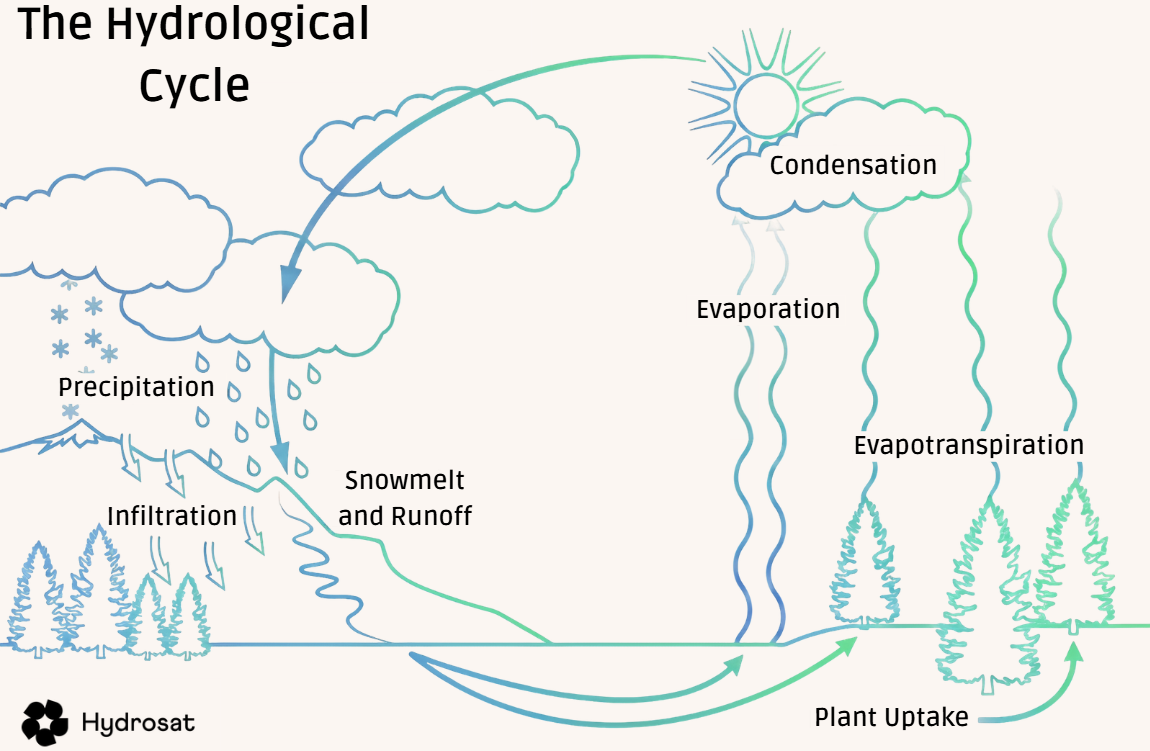
The Water Cycle

The water cycle is the journey that all global freshwater undertakes, when not interfered with by humans. Water falls as precipitation (rain, snow, hail etc.), flows along or under the ground on a variety of routes before being evaporated back into the atmosphere to begin the cycle again.
For agriculture, the paths water can take in the water cycle can be classed into four groups depending on how beneficial that route is to efficient water usage:

Beneficially consumed water

This is the water used by the plant for transpiration and is fundamental to crop growth therefore is considered essential.

In terms of irrigation, this is one of the main factors determining how much and where to irrigate.

Recoverable return-flow of water

The water percolating into freshwater aquifers or returning into drains and rivers is re-entering the water cycle as useable sources. The water is captured and can be reused in irrigation.

In some cases, this is encouraged in agricultural practices.

Non-beneficially consumed water

Intercepted water, soil evaporation, weed transpiration, pipe leaks or water loss from open channels means the water returns to the water cycle but without having had any productive return.
The water continues on the cycle without helping crop growth.

Unrecoverable return-flow of water

Percolation into saline aquifers, drains without downstream diversion, ocean outflow and any other non-recoverable sinks physically or economically are ways in which water cannot be used for irrigation again. The water has left the freshwater portion of the water cycle so cannot be re-used for irrigation.

Non-beneficial and unrecoverable water are what prevent efficient water usage in agricultural practices, and we are seeking to reduce them. 

Considering how important water is...

Water is crucial to our survival, so it may come as a surprise to learn that one of the most critical components of the water cycle, and efficient water management, remains largely unmeasured. A big problem when trying to find ways to conserve water…

Evapotranspiration, known as ET, is the combination of the evaporation of water from the ground and the water emitted from plants via transpiration. 

Outdated Approaches

Previously measurements have relied on ‘closing the water budget’: adding up all the measurable components and inferring ET as what was left over. These traditional approaches, including weather-based models and ground sensors, rely on indirect estimates They provide approximates as ET varies significantly across fields and crops, changing daily with weather and plant health. 

Too many variables

Without accurate measurement, water management is essentially just guesswork with error margins of up to 40%. Even more modern ET measurement techniques still have limitations: flux towers are useful but cannot cover large areas and satellites have the geographical coverage but not all the time. 

The solution

Smallsat constellations are the solution, moving us in the direction of regular measurements taken over the whole globe; scales much more beneficial to agriculture and water management. We are at the beginning of this era, one of accurate ET data everywhere and all the time, so we can make the most of the water resources available without waste or compromise.

Want to learn more? Click below to read about another linked topic

Help us
Improve

Your feedback helps us make our Academy more useful. Tell us about your experience and what you'd like to see next.

Share With
Your Network

Know someone who could benefit?
Share the IrriWatch Academy with your colleagues and network.